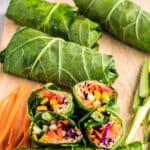
Collard Wraps
Collard greens are very nutrient dense, much like kale, though they don’t get the same attention! I like to use them for collard wraps, which make an amazing vegan, gluten-free, plant-powered lunch!
Servings 1 -2 people (based on size of leaves and fillings)
Ingredients
- 1-2 organic collard leaves (1-2 per person; can use more if leaves are small
- 1/3 cup thick spread or dip to hold fillings ex: hummuswhat-amole, truffle-salted nut cheese
Fillings of choice:
- raw vegetables: chopped cucumber chopped bell peppers, shredded lettuce, grated carrot, grated beet, sliced tomatoes (try to remove extra juices), minced fresh herbs (ex: basil, parsley, cilantro)
- lightly steamed/broiled vegetables such as asparagus spears, chopped green beans, broccoli florets, sliced zucchini
- roasted or cooked vegetables such as sweet potatoes, winter squash, white potatoes, beets, parsnip, cauliflower, grilled or roasted mushrooms
- Condiments/preserved foods: Things that give a pop of flavor like olives capers, sun-dried tomatoes, kimchi (if you're a fan!), pickles, hot sauce, nutritional yeast, seasonings salts, etc
- Seeds? Nuts? If you want to add some crunch try pumpkin seeds, chopped nuts, or nut-free parm
- cooked grains such as brown rice, jasmine rice, quinoa, millet, buckwheat
- Cooked beans such as lentils, chickpeas, black beans, kidney beans, white beans
- cubed or sliced avocado
Instructions
- Choose your collard leaf/leaves. Select ones that are large enough to fill and roll, and also preferably without any tears or holes.
- Trim the stalk. About halfway down the leaf the stalk begins to thicken. Use a paring knife and carefully trim under that thick portion to the base, to remove all that heavy stalk. The leaf will be easier to roll - and chew!
- If you've steamed the leaf (see note), lightly dry it! Use a paper towel and dab off extra moisture. Otherwise, the collard will be slippery for rolling and messier to eat.
- Add your fillings! The fun part! Start with a base to "hold" the fillings - hummus, a nut cheese, thick bean dip, slather of tahini - whatever you like.As long as it's fairly thick to help hold some fillings. Then, sprinkle on your remaining fillings, judging on the size of your leaf.
- Wrap and roll! Starting at the edge, begin to roll your wrap. As you go, tuck in the sides and continue to roll. If, after rolling, you'd like more fillings, you can usually open it up and tuck in a few extra goodies.
- Slice in half and serve.
Notes
Fillings Note: Generally, I like to pair a balance of some fresh/salty/pungent/sweet flavors in a wrap. So, with a spread of hummus, I might then add the broiled zukes and chopped cukes and bell peppers (fresh), then some olives (salty/pungent), and roasted sweet spuds or avocado (sweet). You can play up whatever filling you like. Once you get started, you'll get the idea and not need to measure or even read the recipe! Steaming
Note: Raw or steamed? I like to steam my collard briefly leaves … in my kettle! With steaming, the leaf becomes more pliable to roll, but is more delicate. I prefer the flavor with that very brief steaming. That 10-20 seconds of steam change the texture and flavor!
Kale Note: If you have very large kale leaves, you can use those too. Most kale leaves are not quite as large as collards, but you can certainly do smaller ones and fill a bunch! You can also use lettuce leaves for wraps. They aren't nearly as sturdy, however, so fill lightly - and don't steam the leaves.
Sushi Style: Try slicing into sushi-style rolls (this will be easier with firmer collard greens)